


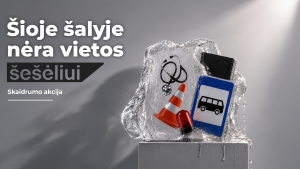
It is estimated that the state loses more than one billion euros each year due to uncollected VAT alone. A new survey of Lithuanian residents shows that people have a fairly clear understanding of the cost of tax evasion to the state and society: 46% of respondents believe it reduces funding for public services, 43% say it encourages unfair competition, and 41% think it increases price differences between honest and dishonest businesses. Yet in everyday situations, the shadow economy remains close to consumers — from “envelope wages” to unrecorded payments in the services sector. The gap between awareness and everyday habits is being highlighted during the transparency campaign “No Country for Shadow” held in Lithuania.
The transparency campaign “No Country for Shadow”, organised in Lithuania for the fifteenth time, began with a discussion at the Martynas Mažvydas National Library titled “Is Lithuania Becoming Honest? The Shadow Economy and Its Cost”. The discussion covered the latest public opinion survey data, the state’s role in reducing the shadow economy, and the importance of fair competition for business and society.
According to Investors’ Forum economist Dr Adomas Klimantas, awareness of the shadow economy and the harm it causes is not enough; the key question is how to turn that understanding into everyday behaviour. “A shrinking shadow economy would mean less pressure to raise taxes on businesses operating honestly, more opportunities to finance public services, and stronger state resilience. Reducing the VAT gap alone could make a significant contribution to budget revenues and ease pressure on public finances”, A. Klimantas said during the discussion.
Finance Minister Kristupas Vaitiekūnas noted that official assessments show the shadow economy and the VAT gap in Lithuania have been steadily declining. “According to a European Commission study, the VAT gap decreased by more than 5 percentage points between 2020 and 2024 – from 18.5% to 13.2% – while the State Tax Inspectorate forecasts that in 2025 it will continue to fall to 12.8%. This shows that the measures applied by the state are delivering tangible results and strengthening economic transparency. At the same time, reducing the shadow economy remains one of our key priorities”, K. Vaitiekūnas emphasised.
The shadow economy is shrinking in labour relations but remains present in everyday services
The public opinion survey conducted by Spinter and presented during the discussion showed that people primarily associate paying taxes with very specific benefits: healthcare (65%), social guarantees (58%), education (46%), public safety (39%), and roads and other infrastructure (37%). Meanwhile, residents most often associate tax evasion with the state’s reduced ability to finance public services (46%), unfair competition (43%), and larger price differences between honest and dishonest businesses (41%).
However, the survey also reveals another side: although labour relations show an improving trend, shadow practices remain present in everyday services. Twenty percent of residents say they know people who, over the past 12 months, had undeclared employment relations or received wages “in an envelope”. Last year, this figure stood at 30%.
Unrecorded payments are also visible in consumer situations: 34% of residents said that in the past year they had paid for beauty or wellness services but did not receive a receipt or any other document confirming the purchase. Sixteen percent reported similar experiences at markets or fairs and when purchasing car repair services, while 14% did so when paying for repair or construction work.
Transparency is a condition for fair competition
For business, transparency is important not only as a matter of reputation but also as a condition for fair competition: the shadow economy distorts the market, increases pressure on companies that pay taxes honestly, and weakens the state’s ability to invest in areas that matter to everyone.
“We are among the largest taxpayers in Lithuania and clearly understand that a strong state is built through a transparent economy. Every unrecorded euro means lower investment in education, infrastructure, and defence, which is why reducing the shadow economy today is not only an economic issue but also a matter of state resilience”, says Giedrė Kaminskaitė-Salters, CEO of Telia Lietuva, a long-standing member of Clear Wave.
Businesses, institutions and schools join the campaign
The organisers of the campaign invite schools and students to get involved. Interactive educational material for upper-grade students has been published on the Baltoji banga website. The lesson is open to all teachers educating a civic-minded generation.
The campaign is initiated by Investors’ Forum and the community of transparency ambassadors Baltoji banga. The campaign partners are the Ministry of Finance, the State Tax Inspectorate, the State Labour Inspectorate, Lithuanian Customs, the National Health Insurance Fund, the Employment Service, Sodra, the Special Investigation Service, and LRT.
Members of Baltoji banga and Investors’ Forum are also joining the information campaign to spread the message that the taxes we pay return to each of us. These include Lirema, Pliusai, Rimi, IKI, CropLife Lietuva, LIDL, Perlas Network, the Klaipėda State Seaport Authority, Enefit, Kolping College, iLunch, Telia, and others.