


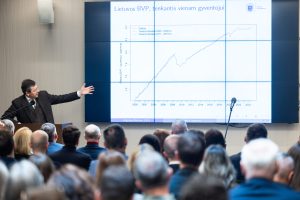
At an open forum titled “Defend the Economy”, held in Vilnius, over 200 business associations invited Lithuanian policymakers to engage in discussions about the country’s proposed tax reform. Economists and representatives from various industry and business sectors emphasized that the current restructuring of the tax system is being carried out hastily and without proper assessment. They argued that alternative methods of funding defense have not been adequately considered, and well-reasoned arguments are being overlooked.
Defense Strength Depends on Economic Health
Associate Professor Dr. Algirdas Bartkus of Vilnius University’s Faculty of Economics and Business Administration highlighted the link between armed conflict outcomes and economic strength. “History shows that the first to falter is the state whose economy cannot withstand the pressure. Therefore, economic health is inseparable from national security and defense prospects,” Bartkus said, stressing that defense financing must go hand in hand with economic growth.
Analyzing Lithuania’s economic indicators, Bartkus pointed out the slowing growth rate of GDP per capita. He viewed this as a warning sign—suggesting that failure to consider the economic cycle could result in harsher conditions for businesses, potentially causing significant social harm. According to Bartkus, when the economy slows or contracts, defense becomes a lesser priority and its funding is reduced.
“International investors’ interest in Lithuania also diminishes,” added Dainius Dundulis, owner of the Norfa group of companies. He emphasized Lithuania’s dependence on foreign investment. “But our country doesn’t seem to learn. We’ve seen companies like Coca-Cola and Kraft Foods move their operations from Lithuania to Poland, where conditions are more favorable. There, they create jobs and pay taxes,” Dundulis said, highlighting how the tax environment affects multinational corporations’ decisions.
As an alternative, both Bartkus and independent risk analyst Šarūnas Andriukaitis–Sutkus proposed borrowing. According to these experts, Lithuania’s debt-to-GDP ratio could be significantly higher—allowing the country to borrow more and still effectively meet its defense needs.
Reform Seen as a Shift Toward Leftist Policy Rather Than Defense Funding
Marius Dubnikovas, economist and Vice President of the Lithuanian Business Confederation, noted that Lithuania’s recent progress is reflected in various OECD indicators and indices—for instance, the country ranks 5th in The Tax Foundation’s Tax Competitiveness Index. “We also see the fastest wage growth and the happiest youth in the world,” Dubnikovas noted, while warning that such achievements are fragile.
“The core issue is the proposal to combine income taxes. A vote in the Seimas could make it unprofitable to hold capital in Lithuania,” Dubnikovas said. He emphasized that never before have so many organizations and associations united against proposed tax changes.
Dubnikovas argued that Lithuania, through this new reform blueprint, has lost sight of the goal to simplify and ease the tax system. He mentioned that associations have submitted over 200 proposals but received little meaningful feedback. “Clearly, the government is not open to dialogue or discussion. As a result, reasoned arguments fall on deaf ears. Even though we have clear calculations showing how the new taxes would disproportionately impact society,” he said. Both Dubnikovas and other experts at the forum concluded that the government’s current plans are more about implementing leftist policies than about securing funding for defense.
Mistakes Come at a High Cost
There are many ways to raise an additional €500 million for defense needs. This amount is not significant enough to justify destabilizing the system, argued Mantas Katinas, head of Wargaming Vilnius and board member of the Unicorns LT association. According to him, the proposed tax reform is a departure from Lithuania’s growth-oriented path of the past 15 years.
“Although Lithuania’s long-term strategy aims to develop high value-added sectors, there is a clear lack of incentives guiding people in that direction,” Katinas said, stressing how the labor taxation regime impacts national competitiveness. He argued that Lithuania should focus on growing the economy rather than redistributing it. “Today, the mobility of people and capital is extremely high. Capital can easily relocate to other jurisdictions—many countries are aggressively competing for it,” he noted.
Meanwhile, Daiva Čibirienė, President of the Lithuanian Association of Accountants and Auditors, pointed out that Lithuania is not making full use of its existing resources, largely due to property accounting errors and inaction. She noted that the State Progress Report has yet to be submitted, even though the deadline has already passed this year.
Čibirienė also listed errors that raise doubts among experts about the feasibility of planned budget revenues and their capacity to meet defense needs. She concluded that it is currently unclear how the state is implementing its strategic financial goals, what progress has been made, and how effective its actions have been. According to Čibirienė, the need for reform has not been clearly articulated or based on evidence—only statistical data have been provided. As a result, the National Audit Office admitted it was unable to identify the purpose of expenditures amounting to nearly €0.7 billion. “That’s about the same amount being discussed when looking for defense funding sources,” she added, pointing out that accounting errors and major data distortions have been recurring for years. Unrecorded state assets prevent the proper use of capital, and it remains unclear how these assets, national resources, and values are being valued, managed, or used.
Sector Representatives Raise Concerns
At the forum, the potential impact of the planned tax reform on different sectors and population groups was also discussed by: Edita Likienė, Presidium Member of the Chamber of Insurance Brokers, Sabina Chochrina, CEO of transport and logistics company Vlantana, Mindaugas Maciulevičius, Chairman of the Kaunas District Farmers’ Union, Chef Liutauras Čeprackas, Domantas Razauskas, Chairman of the Council of AGATA (Lithuanian Neighbouring Rights Association), Lauras Lučiūnas, Board Member of the Lithuanian Music Business Association, Andrius Romanovskis, President of the Lithuanian Business Confederation.
Before the Seimas began deliberating the government’s approved tax amendments, the business community issued an open appeal to Members of Parliament, urging them to reject the proposed tax reform in its current form. The appeal warns that the proposed changes would have devastating consequences for Lithuania’s economy and social well-being. An increased tax burden would lead to rising prices for goods and services, slower wage growth, and reduced purchasing power. The investment climate would suffer, undermining the state’s ability to ensure sustainable and timely financing of defense and other strategic areas.
The business community once again calls on politicians to listen to expert arguments, refrain from rushed decisions, and return to constructive dialogue.
A recording of the forum can be found here.