

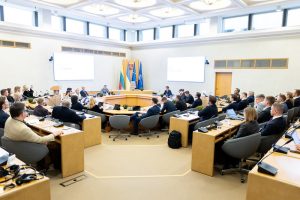
Members of Investors’ Forum, an association representing business leaders in Lithuania, discussed the challenges facing the Lithuanian economy and investment climate at their annual meeting with the Prime Minister and government ministers. Business representatives emphasised that achieving Scandinavian standards of living requires higher productivity and presented nine priority areas for action.
“Scandinavian levels of prosperity must be underpinned by a strong economy. If we want more funding for defence, pensions and high-quality public services, we need to agree on how we will generate the necessary resources. This requires investment and measures to boost productivity,” said Rolandas Valiūnas, Chairman of the Board of Investors’ Forum.
Productivity – the key to economic growth
The Forum highlighted stagnating productivity and declining corporate profitability. An analysis presented by Dr Adomas Klimantas, Economist at Investors’ Forum, shows that economic growth is still being supported by an increasing number of employed people and longer working hours. However, the potential for further growth through these factors is limited.
“To achieve sustainable income growth, we need to create more value with the same amount of work. Yet the current trend is different: productivity is stagnating, while wages continue to rise at the expense of corporate profits. This leaves companies with fewer resources to invest in future growth. Such a model is highly unsustainable. Without productivity growth, there will eventually be no foundation for further increases in household incomes or government spending,” said Dr Klimantas.
Investment – the best way to increase incomes and strengthen security
Encouraging companies to modernise is essential for boosting productivity. Investors therefore propose extending reinvested profit tax incentives to a broader range of sectors.
The expansion of data centres could generate around EUR 100 million in additional GDP and contribute to public finances. Alongside other investments, it would help increase productivity and strengthen Lithuania’s security in the region.
Talent – the foundation of long-term growth
To increase productivity, investors propose focusing Lithuania’s migration strategy on highly skilled workers. Currently, they account for just 5% of all foreign nationals employed in Lithuania, sending an unattractive signal to potential investors in high-value-added sectors.
Migration currently generates approximately EUR 500 million in net annual revenue for Lithuania’s state budget. However, this contribution could turn negative within three years if Lithuania follows the European trend towards increased family reunification. One possible solution is the temporary work permit model proposed by the Office of the President.
Investors also call for greater ambition in education. The goal should be to achieve the best education system among OECD countries. Lithuania currently ranks only 26th in the OECD based on the composite PISA indicator, compared with Estonia in third place. As a first step, investors propose allowing municipalities to extend primary education from four to six years, enabling children to learn for longer in a safe and supportive environment.
Business – a partner in building a more efficient public sector
Business representatives stressed the importance of trust and high-quality public services.
They proposed measuring the cost, waiting times and quality of public services, as well as citizens’ satisfaction. A pilot programme covering 10 public institutions and 20 services could be launched as early as 2027, with the system extended to all ministries and their main subordinate institutions from 2028.
Road quality – a reflection of how well a country is governed
Road quality is one of the first things investors notice. A well-managed country is capable of maintaining roads to a high standard and ensuring their long-term durability. In Lithuania, roads are repaired twice as often as in Latvia or Poland, highlighting the need for higher construction and maintenance standards.
Investors also emphasised the importance of air connectivity. Although executives of international companies may not say so publicly, investment decisions often depend on how easily a particular location can be reached. Lithuania currently ranks third from the bottom in Europe in terms of air connectivity. Improving accessibility alone could generate approximately EUR 150 million in additional budget revenue, while establishing a national airline could potentially generate around EUR 300 million.
AI offers opportunities to reduce the shadow economy
Tax increases disproportionately frustrate those who already pay their taxes honestly, as those who evade taxes remain unaffected. Investors’ Forum members therefore propose using artificial intelligence to combat the shadow economy by identifying unusually high levels of wealth or expenditure that cannot be explained by declared income and may be linked to undeclared or even illegal sources.
This measure alone could generate an estimated EUR 360–540 million in additional state budget revenue.
“We are putting forward concrete solutions and stand ready to contribute our business expertise and analysis. It is essential to agree on the institutions responsible, clear deadlines and measurable outcomes to ensure that these proposals translate into action,” emphasised Vytautas Šilinskas, Executive Director of Investors’ Forum.
About Investors’ Forum
Investors’ Forum brings together major foreign and Lithuanian investors operating across various sectors of the Lithuanian economy. The association represents more than 90 large, reputable companies, including Thermo Fisher, Northway, Tesonet, Telia, Swedbank, SEB, Luminor, Iki, Rimi, Lidl, SBA, Orlen, Omnisend, Hostinger and others.
Its members work to create the most favourable investment climate in Lithuania, built on trust between business and government, an efficient public sector and a strong talent development system. These are the foundations of a safe and prosperous Lithuania.